
One of the biggest problems in functional medicine, biohacking, and longevity spaces is the lack of structure around health
many people are surrounded by ideas, trends, supplements, peptides, gadgets, and protocols, AI
And yet despite all of that optionality, many still make very little to no meaningful progress.
Why is that?
Because trends pull attention in too many directions at once. one week it is a new peptide, the next week it is a different supplement, and the week after that it is a fresh training method or recovery tool.
And the result is not optimization, but sporadic fragmentation.
I know this because I have lived it myself. with years spent switching plans, changing my approach to health and fitness, and bouncing between ideas without enough time, structure, or consistency to let any one strategy fully work.
Looking back, I was the human equivalent of a boat in open water, drifting toward whatever current happened to be strongest that week.
I think a lot of people can relate to that.
When you live in an era like ours, it becomes very hard NOT to chase the next best thing.
But there is a dangeours hidden cost to that mindset, optionality kills your execution.
Too many options create too many open loops.
And too many pathways at the same time mean no road gets travelled properly. Too many “what do I do next?” moments can saturate the mind with plans that never become action.
And this has everything to do with health.
If you want real progress, not marginal progress, but huge strides, then you have to commit your time, effort, and intention into fewer baskets so you can actually get more out of them.
That is my argument for periodization.
One of the biggest lessons I have learned from Brazilian Jiu-Jitsu and from being a health coach is that when your effort is intentional, inputs are tracked, and goals are organized into clear blocks, then you can make huge leaps in your health.
What Periodization Is
The concept of periodization comes from Olympic training and performance
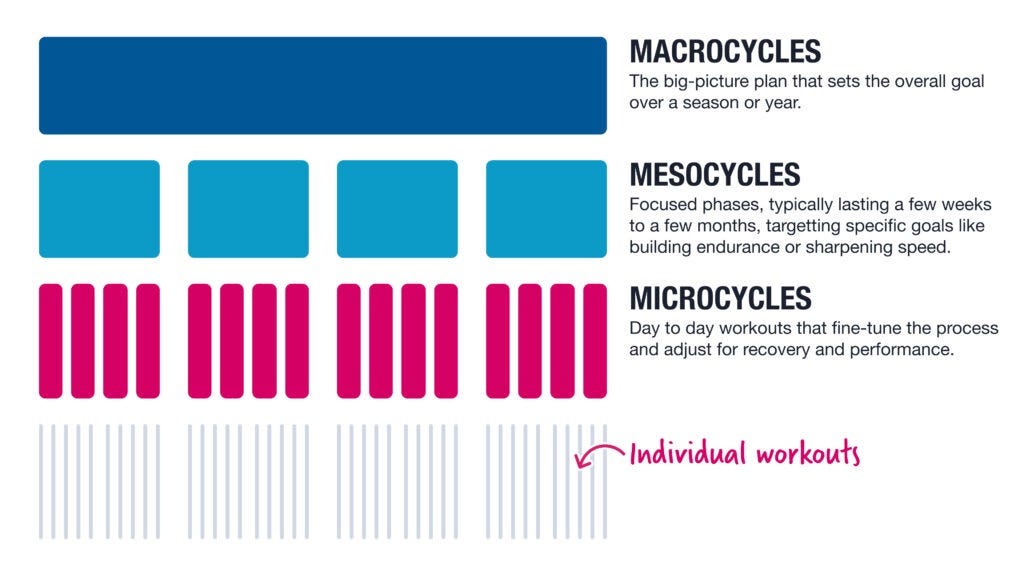
In sport, periodization is the planned structuring of training into phases so that an athlete peaks for the main competition instead of training the same way all year.
In practical terms, it means organizing work across longer cycles, then moving from general preparation toward more specific preparation, competition, and recovery
The core idea is that adaptation improves when training is structured around phases with clear goals rather than one constant, undifferentiated effort.
That same logic can be transferred to health.
How It Transfers to Health
Health periodization works the same way a coach uses training periodization, one major system gets priority for a defined block, while the others are maintained. Then the emphasis rotates across the year.
Rather than trying to improve every biomarker at once, the body is run in quarterly cycles. Each quarter has one main target, and everything else is chosen to support that target.
That means the goal is not to randomly stack interventions.
But create a strong enough signal, held long enough, to produce a real adaptation.
This is an example of a framework:
Quarter 1: immune system.
Quarter 2: vascular and cardiovascular system.
Quarter 3: organ support, especially liver and kidney.
Quarter 4: sleep and recovery.
Immediately, this creates clarity. Instead of trying to optimize everything at once, attention is narrowed to one dominant adaptation per quarter.
How the System Is Built
The part most people miss is that this is not just training periodization
It is intervention periodization.
Each quarter is built around one dominant pathway, and every lever is selected to reinforce that same adaptation. Rather than throwing random tools at the body and hoping something works, the aim is to create one clear signal and amplify it across multiple layers.
In practice, each block could be built from four categories:
Training.
Bioregulators.
Peptides.
Supplements.
These are not chosen separately.
They are chosen together, with each layer supporting the same physiological objective.
That is what makes the system coherent. It is not just a pile of compounds and habits. It is a pathway-specific stack.
Example: The Cardiovascular Block
If the target for the quarter is cardiovascular and vascular health, then the entire block is organized around that outcome.
The training layer is selected to improve aerobic capacity, vascular efficiency, and cardiac output.
That could include the assault bike, StairMaster, zone 2 cardio, and Norwegian 4x4 intervals.
These methods are commonly used to build aerobic fitness and high-intensity conditioning within structured training plans.
Then the molecular and nutritional layers are selected to support the same pathway. In this example, that might look like a bioregulator such as Vesugen, a peptide such as BPC-157, and supplements such as L-citrulline and nattokinase used in the morning and evening. The point is not that any one item works in isolation.
But the whole stack is aimed at the same destination.
Recovery methods then support the same quarter rather than competing with it. Breathwork, sauna, sleep discipline, hydration, and electrolyte support can all be used to reinforce the block rather than distract you from it.
So a cardiovascular quarter might look something like this: (Example block)
Training: assault bike, StairMaster, zone 2, Norwegian 4x4.
Bioregulator: Vesugen.
Peptide: BPC-157.
Supplement support: L-citrulline and nattokinase AM/PM.
Recovery support: sauna, breathwork, hydration, electrolyte support, etc
Why This Works
This is the difference between random biohacking and structured intervention.
If the goal is cardiovascular adaptation, then training creates the primary signal
The other layers are there to support that signal, improve tolerance to the work, and reinforce the same physiology. Instead of five weak inputs pulling in different directions, one strong adaptive message is being amplified across multiple levels.
That is why the system becomes easier to measure
If a quarter is devoted to vascular performance, then outcomes such as blood pressure, resting heart rate, VO2 max, HRV, recovery, and subjective capacity can be tracked against that block. The plan becomes clearer, adherence improves, and the data become more meaningful because each phase has a defined purpose.
The real power of periodization is that it kills novelty the very same problem that most people are struggling from. a lack of sequencing. Periodization brings sequencing back. It narrows focus, reduces noise, and gives the body one clear signal at a time so adaptation has a chance to occur.
Thanks for reading Oran/Biohacker.
Until next time!