
Everything that’s gone well in my life has come through iteration.
We’ve all been there, you start something new, forced to suspend your expectations because you have no idea what you’re doing, and you assume your first take will be far from perfect.
But that uncertainty actually gives you an innate sense of power.
At one point, I was the person who believed there was a perfect way to do things. The reality is: the true art, or end result, usually lies in a thousand iterations.
I’ve seen this directly in martial arts and in health.
Today, I’m tying some of these concepts together in a simple form, in hopes you’ll be able to grasp them.
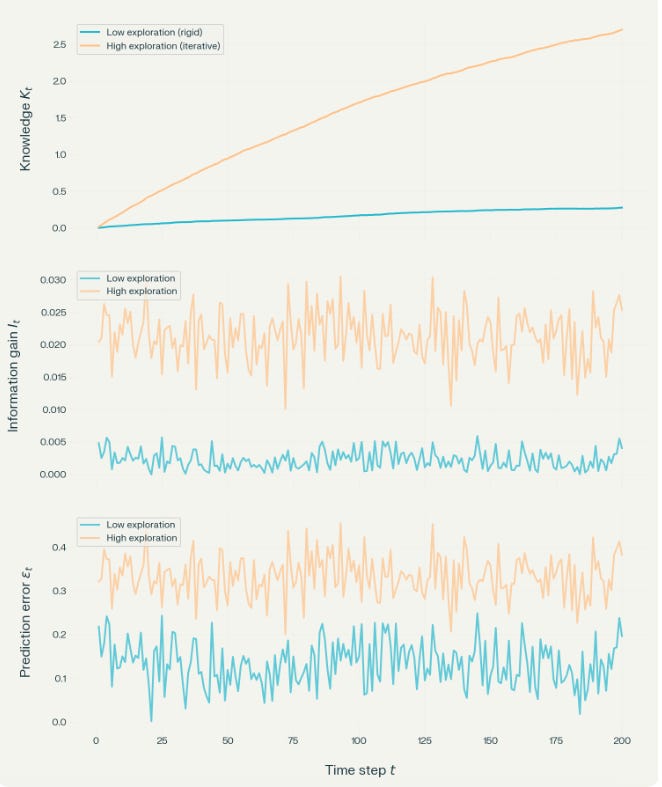
The Iterative Mindset and “Fail Fast”
My core idea or running thoughts are this.
Having an iterative mindset, or using a “fail fast” framework, doesn’t just expose you to more data.
It exposes you to more surprising data.
This ties directly into information theory.
More iterations → higher surface area coverage → a higher chance of luck.
And that “more surprising data” is actually more useful to us
Because it’s what changes our belief systems about the world and the reality we inhabit.
Surprise, Information, and Belief Updating
Think about something as simple as the sun coming up tomorrow.
You’ve already made a prediction that it’s going to happen. There’s almost no new information in that event for you.
Now imagine it raining in the Sahara today, not a common occurrence.
What makes that interesting is there’s a much higher concentration of bits. of information. within that event to learn from.
In information-theoretic terms. surprise is what happens when new data causes a big shift between your prior beliefs and your updated beliefs. Unsurprising events barely move your model of the world. Surprising ones force you to revise
If you’re a perfectionist or a non-iterator, how are you available to see that information?
Because you’re tunnel-visioned into the outcome you want.
Your awareness, expectations, and emotions are siloing you away from the potential to notice that surprising data in the first place.
This is one of the pitfalls of tunnel vision and perfectionistic/neurotic thinking.
Decision Trees, Dogma, and Narrow Paths
When your choice or decision tree is limited, you cap yourself into one way of doing something.
As a result, you’re less likely to run into the non-linear chain of events that would actually expose you to the type of information worth knowing.
An iterative mindset counters this:
More iterations → more prediction errors
You figure out what the thing isn’t
Because you’re more open and spending more time in the “playground” or on the mats
You’re more likely to pick up that surprising information, high-information “bits”
That compounds over time, because you’re mathematically ingesting more information about the environment or space you’re in
In the words of Gurdjieff: “If we do what we don’t like doing, the reward must come later. It is a mathematical law and all life is mathematics…..”
Iteration is how you put that exact law to work.
Let’s ground this in health now.
When dogma limits our range of thinking, we are never likely to run into the people, methods, or forms that can actually help us.
If we assume an identity, I’m a pharma guy”, “I’m a holistic/herbal person”, “I’m a doctor”, “I’m an athlete”, that assumed identity becomes a filter.
We start screening out anything that doesn’t fit our belief system. As a result, we decrease our chances of being helped.
Am I saying you should be gullible to every treatment, intervention, or “next big secret” for your health? No.
You can still exercise caution and critical thinking when you surrender your dogma.
The iterative approach is:
Treat each intervention as an experiment, not an identity.
Define carefully what you’re measuring (symptoms, labs, performance, mood, sleep, etc.).
Run small, time-bound trials.
Update your beliefs based on the data, not the story you or someone else told yourself beforehand.
That’s how you turn health into a learning system instead of a belief system, and its how you see the openness in the world that can actually lead to a healthier way of thinking….
So in short what im trying to say is that IMAGINE finding a method that suggest using an experiment‑based approach increases your exposure to high‑information, belief‑updating events, which in turn makes you smarter, healthier, and luckier over time….
Until next time, thanks for reading Oran/Biohacker..