
In the war against hypercholesterolemia — a genetically inherited condition where individuals are dealt high LDL because of a short straw in the genetics draw
Merck just made a MAJOR move.
They’ve developed and secured approval for an oral PCSK9 inhibitor enlicitide decanoate (formerly MK-0616 in the development trials, now marketed as Lipfendra).
And it could capture a large portion of the cholesterol market, But its also important to remember
Lipfendra isnt your conventional small-molecule drug that most oral pharmaceuticals in development usually are.

Instead, it’s an orally bioavailable macrocyclic peptide that binds PCSK9
The exact protein that destroys your LDL receptors.
Here’s how that cascade works in practice:
1. LDL receptors sit on your cells and pull LDL out of your blood. They recycle around 150 times before being degraded.
2.PCSK9 (a secreted protease, mostly made by your liver) binds the EGF-A domain of LDLR and tags it for lysosomal destruction, which means no more recycling from those LDL receptors.
3. Because Lipfendra inhibits PCSK9 → more LDLR survive → more LDL gets cleared from plasma.
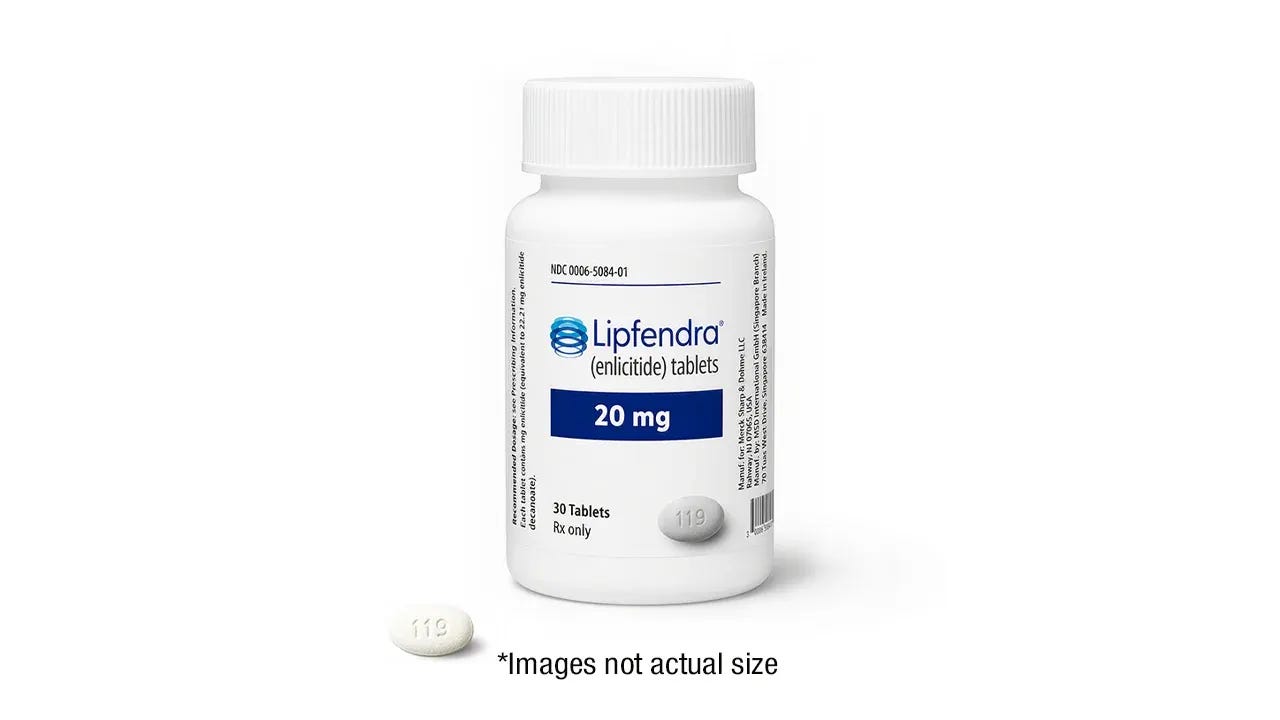
Call that utilising the BODY against itself.
But how does the oral differ from the injectable? You’re probably asking yourself and are they as effective? What are the limitations of both?
>>> Repatha (evolocumab) — injectable:
- Full monoclonal antibody (~150 kDa)
- Binds the EGF-A domain of PCSK9 with picomolar affinity — essentially irreversible
- Stays in circulation for ~11–21 days
- Every molecule of PCSK9 it encounters gets neutralised, wherever it may be in the body
>>> Lipfendra (enlicitide decanoate) — oral:
- Oral cyclic peptide (~2 kDa — 1/75th the size of the mAb)
- Same target: binds PCSK9 at the LDLR interface
- But instead it’s absorbed through the gut (bioavailability of ~10–20%)
- Short half-life (~10–15 hours) → daily dosing required
- Works systemically once absorbed*, but the gut absorption window constrains everything
How effective is it?
Surprisingly close to Repatha, based on the studies that is.
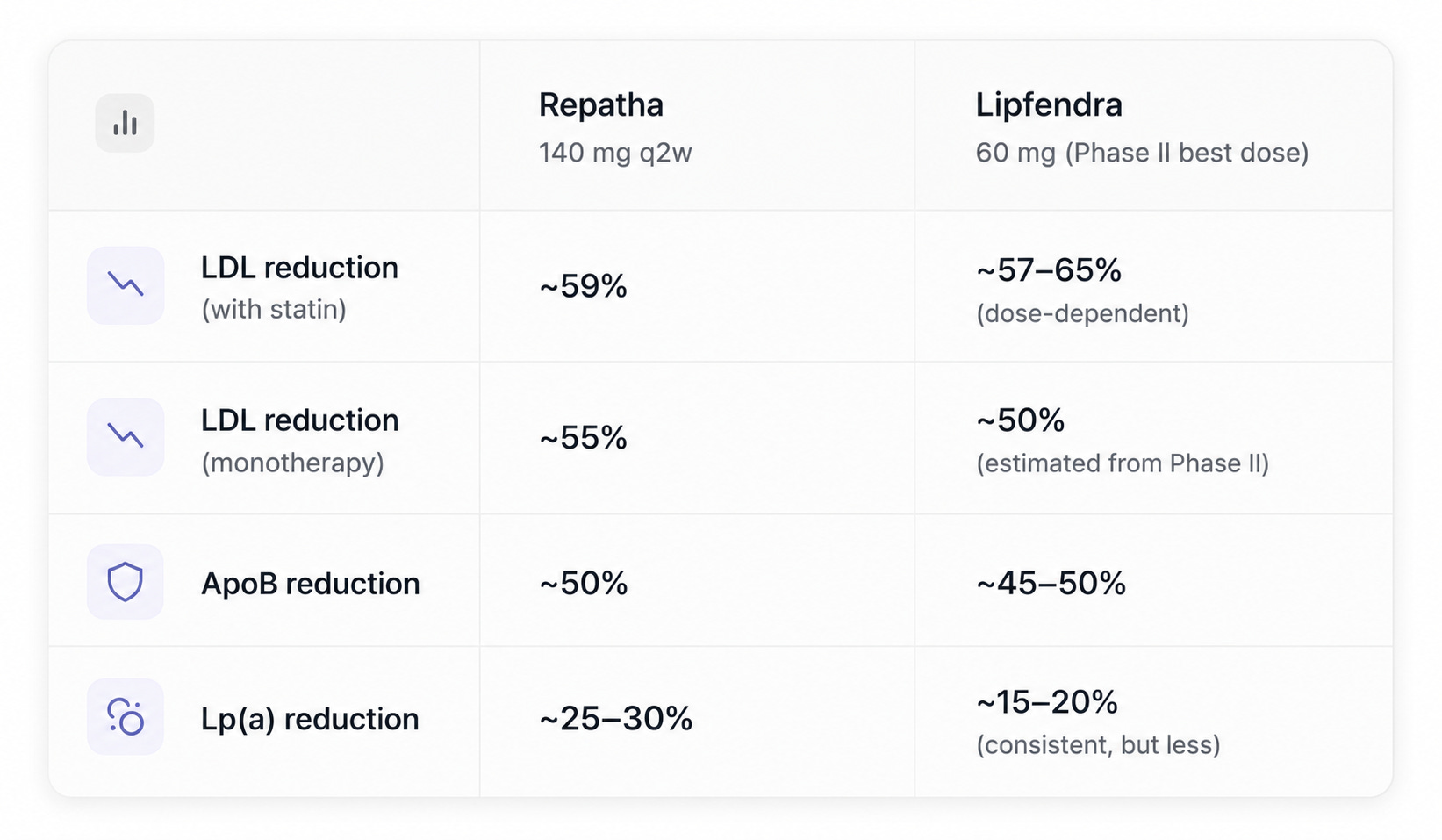
Comparing oral to injectable reduction.
The LDL-lowering is essentially comparable
The mAbs don’t tend to win on the raw LDL reduction
Which is surprising given the pharmacokinetic gulf between both drugs.
The real limitations of the oral
1) Daily dosing vs every 2–4 weeks
This is the biggest trade-off. The mAbs (like Repatha) win on convenience i you’re okay with needles, you don’t need repeated dosing. Lipfendra is a daily pill.
So you’re essentially trading injection anxiety for pill fatigue.
2) Food effect
Lipfendra had a significant food interaction in Phase II trials — so you need to take it on an empty stomach.
3) No long-term data
Repatha/Praluent have >10 years of real-world data — cardiovascular outcomes (FOURIER, ODYSSEY OUTCOMES), safety in millions of patient-years. Lipfendra has Phase II with ~400 patients for ~8 weeks.
So the large safety data doesn’t exist at scale yet.
4) Lp(a) reduction is sliglty inferior
This matters. The ~10–15 point difference in Lp(a) reduction between Lipfendra and Repatha isn’t trivial. Lp(a) is an independent causal risk factor, and it’s notoriously hard to lower. If the oral loses ground here, the high-Lp(a) patient gets less benefit.
5) Manufacturing complexity
Cyclic peptides aren’t cheap pills to manufacture. Solid-phase peptide synthesis at commercial scale can be expensive. Lipfendra won’t be Lipitor pricing
It’ll likely sit somewhere between generic statins and branded mAbs. The pricing calculus is uncertain at the moment.
Where the oral wins (whatever winning is)
- No injection, the obvious one, and it captures that 25% who refuse needles
- No cold chain --- transforms distribution in developing markets
- Potentially lower manufacturing cost than mAb bioreactors (though not by as much as people assume)
- Patient preference early surveys have shown ~70% of patients would prefer an oral over an injectable if the efficacy and cost were equal
The bottom line
Lipfendra matches Repatha on the number that matters most, LDL, but loses ground on Lp(a), the convenience frequency, and the safety confidence that only a decade of outcomes data can actually buy.
And the split decision comes down to if the needle is the barrier or the pill is for you.
Thanks for reading.
Oran / Biohacker