Nicotine doesn’t just “boost focus.”
It reaches into the brain’s reward circuitry, tightens its grip on your stress response, and creates a trade-off most people only recognize once they’re already caught in it.
I know the appeal because I’ve lived it myself. As an ex-smoker, I later found myself experimenting again a few years ago.
This time through the cleaner, more respectable biohacker routes
Microdosed pouches, nicotine gum, the occasional carefully timed piece before a writing session or in the lead-up to BJJ training.
On the surface, it felt different from smoking.
More precise and controlled like a tool rather than a vice.
That, of course, is part of nicotine’s genius.
It rarely introduces itself as a problem, but present itself as an advantage.
That’s really what this guide is about
Stripping away the sleek “productivity pouch” branding and looking at nicotine in plain language.

Because nicotine is neither pure evil nor some elite cognitive cheat code.
It’s a potent plant alkaloid with real short-term upsides, meaningful physiological costs, and an addictive pull that often arrives more quietly than people expect
If you use it, or you’re tempted to, you should understand the whole picture—not just the half sold by optimization culture.
Nicotine’s real identity
Nicotine begins as a natural defense chemical in tobacco leaves. It’s a plant alkaloid, essentially a nitrogen-containing compound that evolved to protect the plant from insects and predators. People sometimes mention that it belongs to the same broad alkaloid family as caffeine, which makes it sound familiar, even harmless. But nicotine acts very differently.
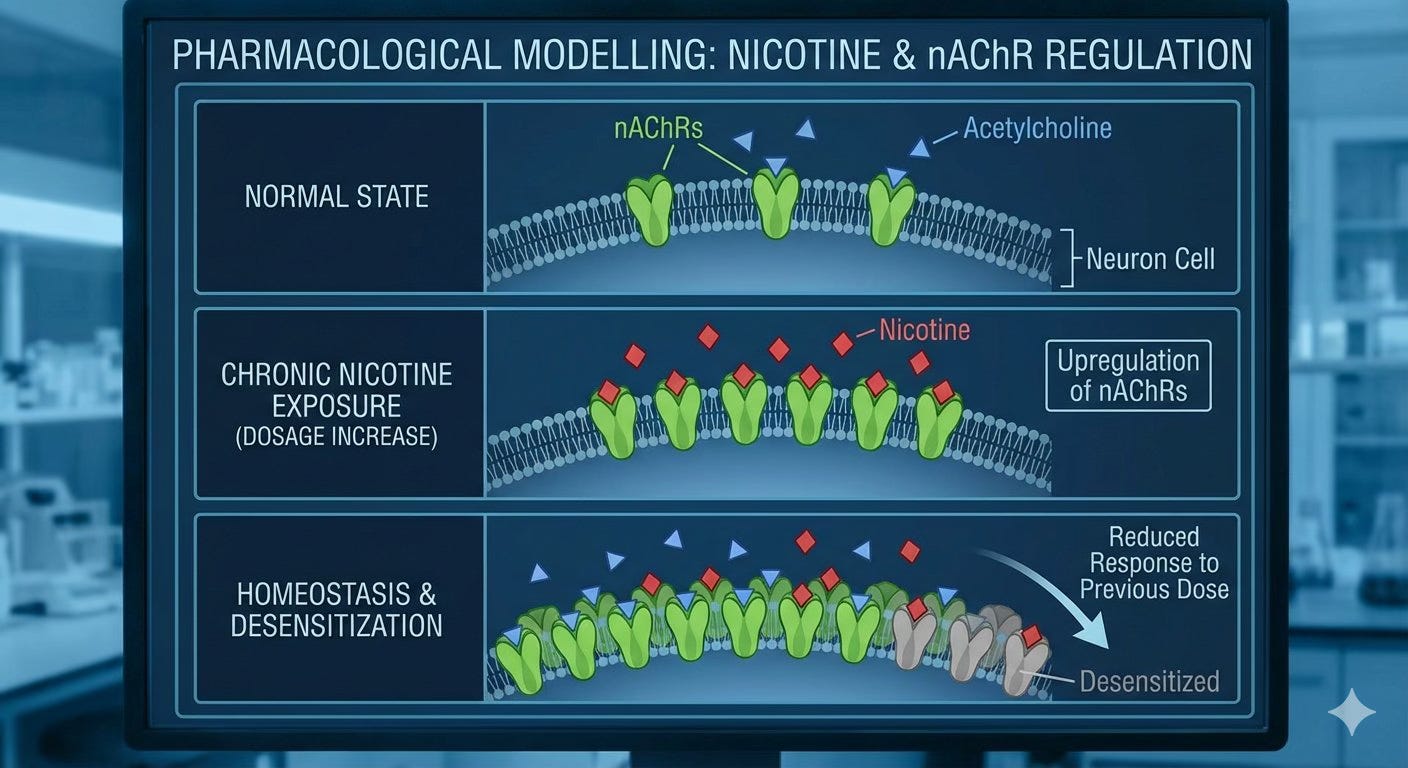
Once inside the body, nicotine targets nicotinic acetylcholine receptors, or nAChRsnAChRs, spread throughout the brain, autonomic nervous system, and peripheral tissues. When it binds to those receptors, it behaves like a counterfeit key: it opens circuits involved in alertness, attention, motivation, and reward. The result can feel clean, efficient, even elegant. Your mind sharpens. Background noise fades. Mundane work suddenly seems more doable.

But that first layer of clarity hides the deeper mechanism underneath. Nicotine doesn’t just activate those receptors
it also desensitizes them rapidly.
That matters because the very same process that creates the “lift” also begins dulling your system almost immediately
The pleasant edge fades, baseline function drops, and the brain starts nudging you toward the next dose. That is where the relationship changes. You think you’re repeating a performance enhancer, but increasingly you’re just relieving the deficit left by the previous hit.
I’ve felt that shift firsthand
One pouch can feel razor-clean, as if someone turned the lights up in your prefrontal cortex
But after a few weeks, the experience changes. You’re no longer arriving at a new peak and you’re chasing the memory of the first one, like how all addiction starts.